


TL;DR
The most consequential AI developments of 2026 are not arriving as announcements. They are accumulating as structural shifts in how organisations position their AI stack, how individuals scale their output, and how the line between human and AI representation is being redrawn. Five trends stand out for their practical implications:
Accelerating AI sovereignty
Hybrid and private deployment becoming the default architectural response to sovereignty pressures
Early emergence of autonomous product management
Orchestration moving from developer tooling to everyday practice
Personal AI crossing into business function territory
While they are at different stages of maturity, all of them have decisions attached that will impact how we use AI in the future. Those who are able to build in ways they can sustain are the ones who will define 2026 and beyond.

We are past the stage of asking whether AI matters. A more useful question is which changes are already in motion and what they are asking of the organisations paying attention.
Here are five trends drawn from what we are observing across client work, sector conversations, and applied deployments. They are the patterns that keep surfacing regardless of industry or organisation size. They are not exhaustive or ubiquitous and not all of them are comfortable, but all of them are important and are gaining momentum enough to deserve attention now.
Accelerating AI Sovereignty
Geopolitical and economic pressures are moving AI sovereignty from a compliance discussion to a strategic one. Enterprises that previously treated data residency as a procurement checkbox are now mapping their AI stack more carefully, asking which components carry meaningful jurisdictional risk and what it would take to transition them. According to Info-Tech Research Group’s AI Trends 2026 report, 72% of IT leaders now cite data sovereignty and regulatory compliance as their top AI-related challenge, up from 49% the previous year.
Focusing on sovereignty demands a structured approach: identifying high-risk elements of the stack, building transition plans toward sovereign providers or solutions, and developing contingency strategies for scenarios where current arrangements become untenable. The organisations doing this work now are not being alarmist, rather they are acknowledging that the regulatory and geopolitical environment has shifted in ways that make this planning prudently necessary. McKinsey estimates that 30 to 40 percent of AI spending could be influenced by sovereignty requirements by 2030, representing a global market of $500 billion to $600 billion. The report also notes that while most enterprises have sovereignty on their 2026 roadmaps, few yet have a detailed strategy or action plan.
For Canadian organisations, this risk has specific legal implications. Under the US CLOUD Act, data held by US-headquartered cloud providers can be compelled by American authorities regardless of where it is physically stored, including in Canadian data centres. Canada’s developing privacy and AI regulatory framework, including the forthcoming Consumer Privacy Protection Act, is beginning to address this directly. The gap between current exposure and regulatory expectation is one that regulated organisations in Canadian sectors cannot defer indefinitely.
Two market developments are following from this. The first is “Sovereignty-as-a-Service” as an emerging category. Most organisations cannot build a full sovereign AI stack independently and vendors are beginning to package compliant, localised solutions accordingly (including us - connect with us to learn more about setting up your sovereign Canadian AI stack!).
The second is accelerating market fragmentation. Countries and regions are developing their own localised AI stacks spanning data infrastructure, models, and cloud, driven by a combination of regulation, security requirements, and the recognition that data control is a form of strategic autonomy. Forrester predicts that 2026 is the year governments will begin taking a “tech nationalism” stance when selecting AI suppliers, with the resulting demand benefiting vendors that have been building sovereign solutions by design rather than adapting to the requirement after the fact.
This means the contractual dimension is also shifting. Sovereignty SLAs are beginning to be requested in vendor agreements, with explicit guarantees covering data jurisdiction, the regulatory constraints governing model updates, and protections against foreign access under specified legal regimes. Many organisations that are not yet asking for these provisions in procurement conversations will soon be doing so.
Hybrid and Private AI as Default
With sovereignty rising as a strategic imperative, the architectural response is becoming equally clear. Enterprise AI deployments are shifting away from pure public cloud configurations to improve control. Organisations in regulated environments are discovering that the governance requirements for AI are difficult to satisfy when core processing happens outside their jurisdiction or on infrastructure they do not own. Forrester’s Predictions 2026 anticipates that at least 15% of enterprises will shift toward private AI deployments built atop private clouds in 2026, driven specifically by rising AI costs, data lock-in concerns, and operational risk; gains in performance are a bonus.
Hybrid and private deployments are becoming the default posture for organisations that are serious about sustaining AI in production. Open-source models are being reframed to reflect this context. Open-source is no longer simply a cost-saving option, but can also be a sovereignty enabler that allows capable AI to run without dependency on externally hosted APIs and the jurisdictional exposure that comes with them.
The split between training and inference is solidifying. The compute requirements of pre-training large models means that core model development will remain globally concentrated for the foreseeable future. Inference, however, is where live and often sensitive data is processed and that is where localisation is accelerating. IDC data suggests AI compute spending is approaching an inflection point by 2027, when inferencing is expected to overtake training as the dominant driver of AI infrastructure investment. This represents a shift with direct implications for where sensitive data will need to be processed and governed. Organisations planning their AI architecture now would do well to consider this sooner rather than later.
The Rise of Autonomous Product Management
Autonomous development is well underway. AI tools are already writing code, running tests, and identifying defects without developer prompting. EY’s March 2026 analysis reports that nearly half of all code on GitHub was written using AI tools by the end of 2025, with agents now handling test-writing, error correction, and multi-hour complex tasks without human intervention. Anthropic’s own research on agent autonomy found that between late 2025 and early 2026, in just three months the length of time coding agents work autonomously before stopping nearly doubled, from under 25 minutes to over 45 minutes, a trend that tracks user experience and growing trust rather than model capability alone.
What is only beginning to emerge, and is worth watching closely, is the next step: autonomous product management. This is where AI agents move beyond execution to engage in the product intelligence cycle itself, analysing usage patterns, surfacing friction, and proposing where development effort should go next. Anthropic’s 2026 Agentic Coding Trends Report characterises 2026 as the year when the systemic effects of autonomous development begin to reconfigure the software development lifecycle itself, pointing toward a trajectory where the boundaries between development and product intelligence are likely to blur.
While great in theory, this is not yet standard practice. Most organisations are still working out how to govern autonomous development, let alone autonomous prioritisation. That said, the trajectory is visible in early-stage tooling and the organisations that are thinking about it now will be better positioned when it matures. The question of who directs product strategy, and what role AI plays in framing that direction, is one that product and engineering leaders should engage with now if they want to shape what is to come.
One implication that has not yet received much attention is shift in UX investment. The value of good interface design has historically been grounded in enabling human users to work efficiently and intuitively with machines. As AI agents become more active participants in software workflows, some of that value proposition shifts. Namely, if an agent can work around friction that would slow down a human, the case for eliminating that friction changes. It does not disappear (human users still matter and will for the foreseeable future), but the calculus is beginning to move. The organisations that notice this shift early will have the opportunity to redirect design investment more deliberately toward the experiences that genuinely require it and let go of the ones that don’t.
Orchestration Everywhere
2026 is the year where individuals learn to deploy AI at scale. Where AI use was largely sequential with one interaction at a time, orchestration tooling now allows a single person to run multiple parallel agents simultaneously, compressing work that previously required teams into timelines that previously required days. Gartner predicts that 40% of enterprise applications will be integrated with task-specific AI agents by the end of 2026 (a sharp increase from less than 5% in 2025), a shift described as moving AI from individual productivity into platforms for autonomous collaboration and dynamic workflow orchestration.
AI orchestration is beginning to reshape how organisations are structured and how individuals think about their own leverage. McKinsey’s analysis of AI-native ventures finds that AI enables small teams to achieve what once required entire departments, with ventures launched in the AI era achieving higher output in faster timelines on both a per-person and per-dollar basis. One-person operations are becoming viable at levels of output and operational complexity that were not previously achievable without staff. Small teams (e.g., five or fewer people) will start to become the operating system for entire businesses, demanding a rethink of enterprise functionality. We’ve heard it before, but it bears repeating - the unit economics of knowledge work are changing in ways that are only beginning to be reflected in how businesses are built or how roles are scoped.
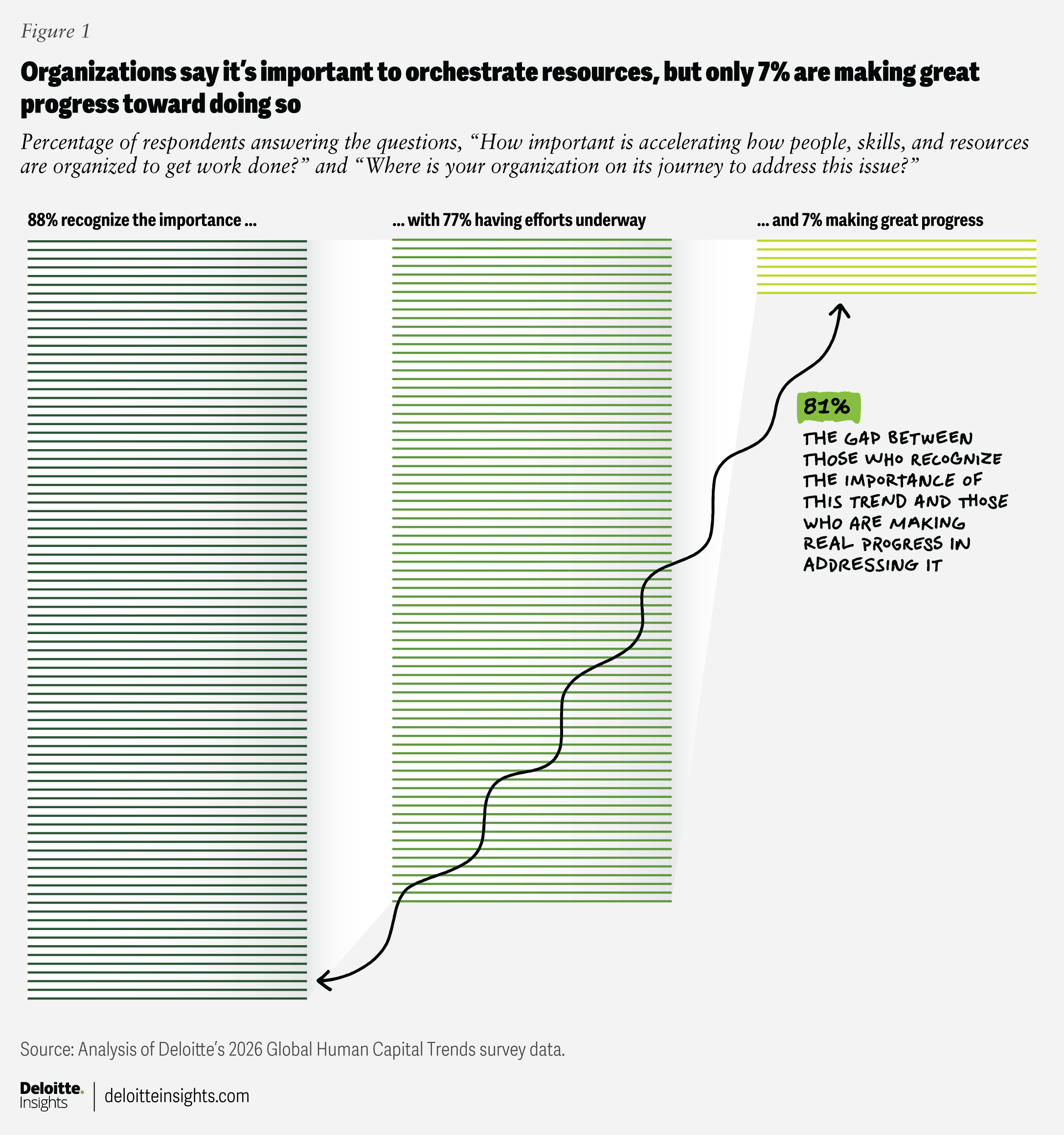
Especially for larger organisations, the implication is less about headcount reduction and more about operating model design. Deloitte’s 2026 Global Human Capital Trends survey of more than 9,000 business and HR leaders found that 88% of leaders consider the ability to dynamically orchestrate work as extremely or very important to their competitive position over the next three years; yet only 7% report making meaningful progress toward it. The individuals and teams who develop genuine orchestration capability will compound their advantage. Successful organisations will have orchestration capabilities that grow as people develop fluency with it and the tools mature around them. Those who treat AI as a series of discrete tools (rather than as a capability) will find the gap widening.
Your Digital Twin is Crossing the Uncanny Valley
Believable AI representation of individuals is continuing to mature, with avatars emerging to support a variety of tasks. So much so that the early adopter question in 2026 is which contexts an avatar representation is appropriate for and what it reveals about those contexts when it works without friction.
One indicator is visible already and that is people beginning to delegate meeting attendance to AI avatars. The Guardian reports on Meta currently developing a photorealistic AI avatar of Mark Zuckerberg, trained on his appearance, voice, tone, and communication style, with the goal of having it hold conversations with employees on his behalf. While this may give one pause, this is not an isolated experiment at the frontier. Raconteur documented earlier this year that the CEOs of Klarna and Zoom have already sent digital doubles to deliver earnings calls and Zoom’s CEO used an AI avatar to deliver opening comments at a recent earnings webinar.
While there are many improvements to be made, the question is no longer whether having a work-context avatar is technically possible. A question that does arise is what it exposes about the meetings being delegated. The ones most easily handed off turn out to be ones that perhaps did not require human presence, judgment, or relationship in the first place. For organisations willing to engage with that observation honestly, this offers a meaningful opportunity to redirect attention toward the work that genuinely requires it.
Personal AI is also beginning to function as a business asset in a more formal sense. At CES 2026, IgniteTech demonstrated an employee digital twin platform capable of building AI-powered replicas of employees using their video, voice, and written materials, able to respond in 160 languages while replicating the individual’s mannerisms and speech patterns. It opens doors for new ways of doing and communicating.
When an individual’s AI capability becomes a material contributor to their professional output, it starts to have employment-level value. Compensation structures, team models, and performance frameworks have not yet caught up with this reality, but the organisations that develop coherent approaches to it first will have a meaningful advantage in attracting and retaining the people who are already building that capability. Building the capacity to deploy and govern personal AI as a business asset (not just permit it) is what will separate the organisations that capture this advantage from those that simply observe it.
In Summary
The AI that organisations will be able to rely on is not the AI that impresses in a demo. The AI organisations can rely on is the AI they can govern, localise, and build capacity around and the leaders are hard at work figuring out how to do just that. Deloitte projects that more than 40% of agentic AI projects will be cancelled by 2027, not because the technology fails, but because organisations try to automate existing broken processes rather than redesigning how work gets done.
Understanding where trends like the ones above are actually heading and building toward that future rather than around it, is one of the more reliable ways to avoid wasted time and resources. Understanding this distinction is what separates approaching them with enough clarity to make them work or discovering what they require after the fact. Those who are able to build in ways they can sustain are the ones who will define 2026 and beyond.
Want AI that Works?
Atomic47 Labs specialises in creating high-stakes AI solutions that provide absolute reliability and data sovereignty. We make AI that works (and keeps working)! Whether you are looking to automate complex workflows, secure your data pipeline, or grow your AI capabilities, we can help you build AI systems and strategies that you can actually trust. Connect with us to see how!